Showing posts with label Stage III. Show all posts

Monday, March 17, 2014

Why I Have Breast Cancer on My Femur

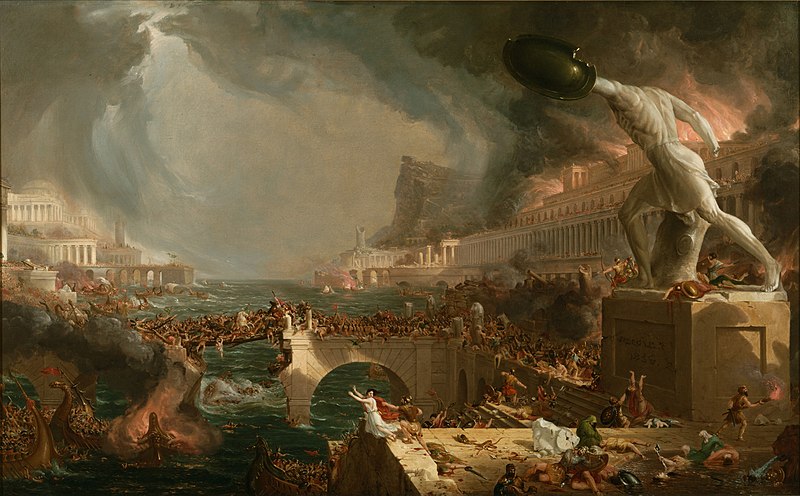
Thomas Cole - The Course of Empire: Destruction
Common thing to wonder: Why do you have breast cancer on your femur?

Philosophical answer:  Beats the heck out of me.  One day I work up and there it was.

Explanatory answer:  A lot of people are wondering why cancer on my bones isn't called bone cancer.

I know it sounds a little weird to say I have breast cancer on my bones, but there's actually a good reason for it.  It goes like this this: cancer isn't an invader, at least not in the classical sense.  Cancer isn't something I "caught" from the outside the way you would a virus or germ.  My cancer is all me.  All natural.  Completely homegrown.

Cancer is my own cells, in this case cells from the milk ducts my (former) breast that went a little crazy.  One or two of my own cells changed a bit and overcame the things that would normally keep them in line and kept them growing in nice, tidy, duct-like ways.  Insteasd, they got out of control and kept growing willy-nilly, dividing and redividing and forming a couple of masses made up of cloned copies of their mutated selves.

The masses got big and broke through the ducts where they started, spilling into to the surrounding tissue.  They continued growing and even added access to my blood supply to continue feed the bulk of them as the mass grew larger and larger. At some point, some cells broke off and left the area in search of new places to colonize.  Some traveled through the lymphatic system, which is why I had cancer in and around the lymph nodes under my arm.  Some may have gone through the blood system, too, but there's no way to know for sure about that.

What we can tell is that in their quest for world domination, when these cells left the breast they formed new lesions on my bones, making a new home on particularly bones that have a rich blood supply and can feed them in a manner consistent with their needs.

Without intervention, they just keep growing and trying to spread out without realizing that in doing so they're jeopardising the very thing they need to survive.

Brief semi-religious deviation: I think of these cancerous cells like Adam and Eve in the garden.  They want to be like God but they only know the parts of God they themselves experience and have no idea of all the things outside of themselves that being God involves (of course, clearly, neither do I).  These cancerous cells seem hell bent on taking over, spreading out and pushing their way into the places of me that will best support their continued growth and quest for domination.  But  what they don't understand is, if they win, they really lose.  They can't be the God of me because taking over everything would kill me and without me there is no them.  Their view is limited to the inside of my body and they act like they think my body is all there is and could support them forever no matter what they do.

Stupid cancer.

Continued somewhat anthropomorphic but otherwise factual explanation: So now they've set up shop on a few of my bones.  But they aren't bone cells gone rogue (which would make them real bone cancer), they're still breast cells. Breast cells with mutations that have colonized on my bones, but breast cells nonetheless.

And the important thing is, they still act like mutated breast cells.  They have some characteristics that come from those ductal cell origins that, hopefully, can be be used against them to stop them or at least seriously slow them down.

But if we were to treat them like bone cells gone all crazy on me, that wouldn't work so well because bone cells don't act the same way as breast cells (which, actually, probably goes without saying) and bone cancer doesn't necessarily react to treatments the same way breast cancer does.  Even when the breast cancer is currently thriving in my bones.

And that's how I came to have breast cancer on my femur.

Monday, March 10, 2014

Waking the Sleeping Giant

Goya - Sleeping Giant
I try not to dwell too much on how this cancer developed.

I keep hearing how looking back and assigning blame doesn't help much, and I'm sure that's true.  I mean, even if I had knowingly and willfully doused myself in carcinogens in my younger days, once the cancer's there it's there and there are no points granted for good behavior.

But I also know full well that part of the reason I can put guilt out of my head is almost certainly because I was blessed with the luxury of not happening to be able to point to any of the avoidable risk factors for breast cancer in my past. I don't think women who have should blame themselves, either--hindsight is always 20/20--but I know it eases my mind to not be able to identify anything that I could say, "Why didn't I just ___?" about and believe it would have made a difference.

I don't have a family history, I ate well, exercised, kept a good weight most of the time (there was about a year when I bumped up into the "overweight" category but I'm not going to pin all of this on that one stupid year), all the things you're supposed to do.  I don't have either of the BRCA mutations. I went through all my stage III treatments, took vitamin D, refilled my tamoxifen prescription before I was out and took it as directed. Every single day.

I even had a "clean" mammogram 6 months before my diagnosis (of course, we weren't talking about density in 2012, and I have no idea if it would have mattered or not. But probably not because in the world of breast cancer, 6 months isn't that long, even at grade 3).  And still here I am.

And unfortunately for the world, my blessing of not feeling like I have to blame myself is, for the rest of the world, kind of a curse.  What I mean is, if you could just point to something and say, "that's what happened, that why she got cancer, that's why it's back," then you might be able to say, "that's why it won't happen to me."  And, unfortunately for everyone else in the world, that's not the case.

All kinds of women at all ages from all kinds of locations and all walks of life end up here.

And I'm sorry about that. I really am. I wish I could tell everyone in the world that they don't have to worry (not that I actually want to blame myself, either, of course). And the truth is I can't.

The same thing works the other way, too. There are women who live for decades with metastatic breast cancer. Lots of them. And there are also women who don't. At my Dana Farber appointment, the oncologist there ran through some things that bode well for my future survival (ER+, bone only, not so agressive that it was everywhere at diagnosis) and some that were possible signs of worry (tamoxifen resistance, less than 2 years to mets), but the truth is, despite good signs and bad signs (and more good signs than bad signs), there is no way to know for sure what will happen until it happens. And so I keep listening to people who know as much as anyone knows and keep doing the best I can. But, despite fervently wishing for it, there's no guarantee (well, ok, let's be real, I really only want a guarantee if it's positive, anyway).

I try not to worry too much about the things I can't control.  If nothing else, I don't want to spend my time as a freaked out mess any more than can help.  And I try really hard not to worry about things I can't control.  That goes for reasons why this happened to me and and reasons why I may or may not have a good run at stage IV.

Sometimes I'm good at not worrying and sometimes I'm pretty bad at it.  Clearly, at least for me, sometimes it's easier said than done (as you can tell by just reading back a few posts on this blog).

I don't know what woke the "sleeping giant" that is cancer in my own body and I don't know for sure what it will take to slay it or at least lull it back to sleep.

And so, while I certainly hope the best modern medicine has to offer does it the trick, both for me and the thousands of other women looking at this kind of diagnosis, I'm trying really hard to live in the moment and leave the rest to God, whatever "the rest" turns out to be.

Wednesday, November 20, 2013

How I danced with the red devil and shot mustard gas through my veins.

Sounds kind of poetic, doesn't it?  Poetic and a little hardcore.  I like that.

Like many, many stage III breast cancer patients, I was given a chemotherapy regime of dose dense Adriamycin and Cytoxan for 4 doses over 8 weeks, followed by Taxol for 4 doses over 8 more weeks.
 
Marc Chagall's "The Dance"
Adriamycin is red and strong and, according to multiple sites on the internet, is sometimes called "The Red Devil"--not that anyone in the cancer center ever called it that in my hearing, of course, because that would be rude--but for each infusion of it I watched them hook the red bag to the IV in my port and watched the Kool Aid punch red liquid flow through the tubing and into my body.  Later that day, the same red had made its way around my body and remained red as it made its way through my kidneys and out of my system.

Cytoxan, on the other hand, doesn't need a hardcore nickname.  It isn't mustard gas exactly (a little poetic license on my part) but it's a nitrogen mustard akylating agent and a close cousin to the chemical warfare agent.

These, as I mentioned, are followed up by taxol, which for many people is the easier part of the ACT chemo with fewer harsh side effects.  For me, it actually seemed a bit harder--taxol is when I finally lost the last of my lashes and brows and dealt with the worst bone pain and neuropathy, expressed as both numbness and as a relentless, prickly pain.

Dose dense means that the doses are given closely together (without being deadly, of course) and this feat is accomplished with the help of a variety of anti-nausea agents and another drug called Neulasta which requires a second visit 24 hours after the chemo infusion but is required to increase production of white blood cells killed off by the chemo.  Not that the white blood cells ever got to normal-person numbers, but the Neulasta helps you get enough white blood cells together in your body to continue with the chemo.  The goal of dose dense scheduling is to keep hitting the cancer cells hard and deny them time to recover between infusions.  It's the chemo equivalent of a constant seige.


For me, the particular chemo I would have was discussed after my surgery, during a visit with my oncologist.  Before surgery, my cancer team had thought, based on the MRI (and possibly some of the other scans I'd had--I'm not really sure anymore) that I would probably be stage II, with a decent chance of avoiding chemo altogeter.  Immediately after surgery I knew they had found a lot of cancer in the lymph nodes, but I guess I didn't put 2 and 2 together because it wasn't until that appointment that I finally understood I was now stage IIIa.  I am proud that at that appointment I held back my tears and I was able to keep it all together enough to talk about the most important thing at the moment: where we were going to go from there.

I had, of course, learned enough about the different stages before that appointment to know the general trends in odds and stages, but it wasn't until after I'd finished with chemo that I finally asked my oncologist about how that related to me.  Weird, I know, but at the time I figured no matter what the odds were, for me it's just binary--either I'm alive or I'm dead and odds don't change that.  Now I care more about the odds, and at times I cling to them like a cross, but when it was all new and I was just trying to get from one day to another, I didn't see any reason to bother asking.  I knew stage III was not good news and when she said we really needed to hit the cancer very aggressively, and she recommended dose dense ACT chemo, even with it's side effects, I was all in.

As I understand it, until they develop something new, dose dense ACT chemo is the most aggressive chemo they give for breast cancer, equalled in aggression by some other 3rd generation regimens but, as the phrase goes, never surpassed.  It's also extremely common for stage III her2- breast cancer, so I have a lot of sisters in this.

Side effects can include heart damage and permanent neuropathy, so it isn't given without a good reason, but lots of cancer that's already spread through the lymphatic system counts as a good reason.

I remain grateful to have had this kind of chemo in our bag of tricks to throw at this.  My cancer was a nasty, aggressive kind, fast moving and mean, and I needed something heavy to throw at it, but it was hardly fun, because, well, because chemo.

But at the same time, now that it's over, in a lot of ways I enjoy being able to say I did that and made it through.  It makes me feel like a badass punk kid who you better not mess with because I eat barbed wire for breakfast and spit nails for lunch.  And, coming from a place where cancer seriously messed with my body and tried to take my life, I feel like I can probably give myself permission to indulge my inner "don't mess with me" from time to time.

I like to think my stage III sisters and I are a hardcore bunch, and, to me, that has a lot to do with having to learn to live with lots of fear and uncertainty, having to adjust to viewing victory as a moment on the road that may or may not be a lasting endpoint, having to understand about not enjoying the luxury of giving "quality of life" more weight than therapeutic benefit.  Maybe that's not the case for all of us at stage III, and I won't even try to speak for other stages, but from my experience and experience on my favorite cancer forum, I think it's something a lot of us do struggle with and feel pushes us just a step or two outside the usual circle of breast cancer patients.

I'm really not trying to diminish the battle of other women who were lucky enough to have been an earlier stage.  Heck, I thought I was one myself and it was still a fight.  I understand that even stage I and II can metastasize and, despite better odds, it's still scary.  Plus, I know I am very fortunate not to be working out stage IV issues right now.

The odd thing is, I've been rewriting this post a number of times trying desperately to say what I want to say without sounding like I'm not appreciating the struggles of other women at other stages and places.  But at the same time, I wonder why I can't say just say, "we took on something that was damn hard and we fought our way through.  Other people did other things, but we were here and we did this."  We've been through a lot to have this chance at life.  And right now I'm not in a mood to downplay that.

I've said before (and I meant it) that I'm not brave, just stubborn, but I'm also strong.  I mean that, too, I know I'm strong.  I danced with the red devil and shot mustard gas through my veins, and I'm still here to tell the tale.  You don't want to mess with me.

Thursday, November 14, 2013

Tamoxifen, my new best friend

Ah, tamoxifen.  Nothing quite like it to divide groups of cancer survivors.

Go on, just look at any forum for breast cancer survivors.  Find a couple of survivors and ask them what they think about it.  Join me at my cancer rehab exercise group, very first day a long-term survivor there brought up how she refused to take it all those years ago and, hey, still alive thank you very much.

As for me, I love the stuff.

For those of you who aren't going through it, tamoxifen is probably something you've never heard of.   But if you've had breast cancer or are close to someone who has, it's going to come up.

Tamoxifen blocks estrogen receptors on cancer cells--in some other parts of the body it acts like estrogen and in some it also blocks.  Many breast cancers are what's called "hormone positive" which means they feed, in part, on estrogen (and progesterone, too, but it's related).  And, thanks to tamoxifen, if you have this ER+ kind of cancer, it's considered a good thing compared to ER- because drugs like tamoxifen can help keep it at bay.

Tamoxifen has been around a long time, it's been generic for over a decade and was, of course, patented before that.  There are other options for women who have gone through menopause (either natural or long enough from chemo to know it's permanent) and don't have bone loss or certain other conditions, but for many women, women like me, tamoxifen is the only real game in town. 

And, unlike chemo and radiation, you keep your hair, don't lose your white blood cells, don't get nausea or neuropathy or any of the other not so fun side effects, and it's just a pill to swallow and you're done.

So, you may be asking, if tamoxifen is so wondrously fabulous, what's not to love?

Well, it's not without side effects, and there's lots of discussion about them, and, frankly, lots of fear.

The biggest side effect for many people, myself included, is hot flashes.  I've been having those since before tamoxifen when chemo put me into instant menopause (did you know aggressive chemo regimens did that?), but tamoxifen can keep them coming.  In my case, after almost a year on tamoxifen and a year and a half since chemo, they're getting less frequent, but still there.

The other one lots of women talk about is weight gain.  I haven't had that one, or at least not that I couldn't better correlate to excess ice cream and lack of exercise, and my oncologist says that one hasn't been shown in clinical trials and people seeing it may really be seeing their metabolism slow down as they get a bit older.  But it's one people talk about--when the no-tamox woman in my exercise group heard I was taking it, the first thing she asked me was whether I gained a lot of weight on it.

Joint pain is also mentioned a fair amount.  I wonder about my current hip thing, but it's pretty constant and doesn't move from joint to joint and it does seem better after almost 2 weeks of rest, so probably not, but who can say for sure?

But aside from those, which, let's face it, are annoying but not serious, there are some rare but serious side effects like blood clots, cysts, thickened uterine linings, and in rare cases uterine cancer.  And if you read all the things that don't come out in studies but people blame on tamoxifen?  Lets just say it covers a lot of ground.

So, why do I take it?

Because, simply put, it gives me a much better shot at staying alive.   Tamoxifen adds 18% to my odds of living past 50--for those of you who care about stats, that's absolute risk, not relative, so 18 out of every 100 women in my position (Stage III, grade 3, and some other particulars that matter) would be dead in 10 years were it not for tamoxifen.

Let that one sink in for a minute.

How much it helps any one person depends on the characteristics of her particular cancer and what your risks of metastasis (aka stage IV, cancer back in places like your brain, liver, lungs, bones) are in the first place.

And that's something your oncologist can talk over with you.

But, for many women, myself included, the risk of dangerous side effects is so much lower than the risk of cancer returning.  And once cancer returns outside the breast, you may be able to keep it contained for some time, but you're pretty much guaranteed to die of cancer (eventually, hopefully) and be in treatment on a constant basis before that.

So, knowing that, I pretty much willed myself to be grateful for tamoxifen.  I decided to make it my new best friend, because, really, working daily to save my life is a pretty friendly thing to do.

This is what I believe about tamoxifen:

  • It is not a money making ploy by "Big Pharma" and your doctor doesn't make money by prescribing it to you!  Come on, it's generic and has been for years--no pharmaceutical reps are pushing it to doctors, no one is fudging the figures for the past 20 years.  That's just silly.  (I'm planning on addressing this kind of thing more in a future post, but I need to get it out while I'm on the tamoxifen topic)
  • There can be some annoying side effects, but for me and many other women, it's a choice between hot flashes and greatly increased odds of death--trust me, I can buck up and take the annoying side effects in exchange for, you know, life.
  • There are some risky side effects, but if you're concerned, talk to your oncologist.  No really, sit down and talk to your oncologist.  That's what you pay her or him for.   Your oncologist has the figures and can talk to you about them.  But if you have a 0.1% chance of blood clots with it and a 18% greater chance of being dead without it, well, you've probably placed bets with worse odds than that.
  • The annoying side effects stop when the tamoxifen stops.   A lot of women seem to be afraid to even start taking it, but if it gives you real trouble, you can always stop taking it (but, please at least talk to your doctor about substitutes (like ovarian suppression and AIs) that might be better for you).
  • The annoying side effects may get better with time.  It's anecdotal, but lots of women say they do and that seems to be the case for me, too. They're now saying 10 years on tamoxifen is a good idea, but remember you may very well find it's 1 year of hot flashes and 9 years of perfectly normal life. 
  • There are some things available that can mitigate the side effects--if you're having a really hard time, talk to your doctor before you just up and quit.  There may be something easy you can do to fix the problem and still get that better shot at living.  
  • Tamoxifen is tamoxifen.  You may be the classic black box warning for some other drug, but that isn't much of a predictor for how tamoxifen will interact with your system.
  • The truly sucky thing about cancer and mets is there are no do-overs.  With all this cancer stuff it's true, and it stinks.  There really is no, "I'll try x and if it doesn't work, then I'll do the something else," and that scary.   It's literally life and death here.  Sobering, frightening, but maybe also focusing in its own way.
It's kind of funny, I hate disagreeing and generally avoid confrontation and confrontational topics.  I guess this tamoxifen thing has been kicking around in my head too long and seems to have built its own soapbox.  Which I seem to have been all too glad to step on and start preaching.

But, tamoxifen is important to me.  If there were 10 of me in a room, two of us would have our lives saved by it.  And I hate the sweaty, blushy hot flashes.  I hate thinking about blood clots and uterine cancer.  And if there is weight gain to be had, that's not something I'd welcome with open arms.

But more than those things I hate wondering if I will live long enough to see my girl grow up, see my unmarried stepkids get married and my married stepson start a family.  I want to grow old with my husband and see how this story ends.

And if tamoxifen can help me make that happen, I am grateful.  Grateful enough to endure some hot flashes and joint aches if that's the price of living.
Saturday, November 9, 2013

Post 2, in which I live to fight another day

Saying, "Thank you, God!" a lot over the past few days.  My hip is irritated and has some inflammation but does not have any apparent cancer.  Thank you, God!

So, I remain stage IIIa and continue on my current path of tamoxifen (an estrogen blocker because my particular cancer feeds on estrogen) and efforts at healthy eating, with a little break from my efforts at getting enough exercise in a attempt to rest the hip.

A recurrence scare is (obviously!) no fun.  It's terrifying for me and terrifying for my family.  But, in a strange way, I think it has a weird bright side--it forces me to face the possibility of progressing to stage IV and helps renew my determination to do what I can to prevent that.

To be very clear, especially to anyone whose view of breast cancer is mainly happy partying women in pink tiaras, tutus, and boas, all the early detection and treatment in the world can not prevent all breast cancers from progressing.  Plus, we can determine the odds that the cancer will return, but we can't determine WHO will be free of progression and WHO will die of this.

Let me repeat that, all the early detection and treatment in the world can not prevent all breast cancers from progressing.  We can determine the odds that the cancer will return, but we can't determine WHO will be free of progression and WHO will die of this.

The rearview mirror is shiny clean, but the windshield is pretty cloudy.

But there are things that studies have shown statistically decrease the odds of moving to stage IV, and those include taking my tamoxifen (which is not without side effects, but better than terminal cancer, at least in my book), eating a healthy diet with lots of fruits and vegetables, maintaining a healthy weight, and getting enough exercise (interestingly enough, that's independent of any weight-loss it may add to).

Since we all know how much fun those non-pill activities can be in practice--let's face it, they sound good, but who really wouldn't rather just eat a cookie and not sweat?--a little renewed focus can be a good thing.

And so I move on, doing the best I can to do what I can and keep on the fine line between being vigilant and careful, and living life without fear.  Or without excessive fear.  Or with occasional excessive fear but not debilitating fear.  And gratitude.  Always gratitude.