Showing posts with label defining terms. Show all posts

Sunday, May 31, 2015

A little bit of housekeeping

Two quick things: a correction and an option.

The correction: On my last post, I mentioned that the results of the PALOMA-3 with news on whether Ibrance is helpful in Overall Survival (how long people live) in addition to Progression Free Survival (how long till the cancer evolves around it and grows again) are expected to be presented at ASCO this weekend.

This is not actually true! 

It's sort of half true, but that doesn't count for much.  The actual truth is that the results of PALOMA-3 will be (or have been) presented at ASCO this weekend, but those are aren't Overall Survival (OS) for Ibrance and letrozole.  They're actually Progression Free Survival (PFS) of Ibrance and Faslodex--the results are very good, and Ibrance more than doubled PFS over Faslodex alone, from a median of  3.8 months to 9.2 months, which is, as I understand it, an almost unheard level of improvement in cancer drug development.  It's similar to the improvement found with Ibrance and letrozole over letrozole alone and all points to Ibrance being a really big deal in the treatment of hormone receptor positive metastatic breast cancer.  A huge big deal.

For me, personally, it's probably not that useful since I've already flunked out of Faslodex, but it will be big for a lot of women in the future, so that's really good news.

The study results I was thinking of about Overall Survival with Ibrance and Letrozole are actually Phase III of the PALOMA-2 trial (not phase II of the PALOMA-3 trial, but maybe you can see where I went wrong there!) are due out in October.  And I'm still anxiously awaiting those, though even more anxiously awaiting getting to the my next scans and seeing how Ibrance and Letrozole are working for me!


And the option:  I've just made a Facebook page for this blog for people who like to use Facebook to follow blogs.  If that's you, here you go!  You can go directly to www.facebook.com/mepluscancer or click the Facebook icon to the top left, and (either way) "like" the page.

If that's not you, or you just don't want to follow this one there, no worries.  And I promise this is the last I'll mention it.  And there will be no "give-aways and please, please, please like it" posts.  Because I don't like those.  And also, this is a blog about metastatic cancer so what exactly would I give away, anyhow? (Can you see it now?  300th person to like it gets an empty bottle of letrozole, 400th gets an Ativan info sheet and an empty bottle of Ibrance--whoot!)


Sunday, November 9, 2014

Of scars and bone


From Katie Thamer Treherne's lovely
The Light Princess illustrations.
When I was in high school, I used my own money to sign myself up for some adult beginner ballet lessons.  For pretty much my entire childhood I had wanted to learn ballet--never mind that the '70's and '80's were an era where the ideals of girlhood were more about sassiness and tomboys (think Paper Moon and The Bad News Bears)--underneath my '70's and '80's approved tough-stuff exterior, I longed for pink slippers and tutus so badly I could practically taste it. 

As instructed, before my classes began, I had gone to a local ballet shop and was fitted for a pair of soft pink Capezio ballet slippers.  And because it's not like I just started being a dork when I turned 40, after I brought them home, I spent a fair amount of time looking them over carefully, noticing the little pleats under the toe, the soft sheen of the fabric binding where the cord threaded through, the feel of that buttery soft, gently pink leather.  And it fascinated me that one of the slippers had a little scar in the leather, a tiny curved line healed over from a little cut where the animal must have brushed against when it had still been alive.

I was reminded of that scar again talking to my oncologist this past visit.  It turns out that our bones also scar.  With bone mets, the whole idea of NED (No Evidence of Disease) is a bit of a misnomer.  Even if my cancer were to be completely wiped away, the evidence would still be there in the sclerotic areas (abnormally dense and irregularly formed bone growth) growing in where the lytic (bone destructive) lesions had been.  Even if we were to get to a state where my bones were completely free from cancer (granted, an unreasonably lofty goal at the moment), like that little scar near the toe of my ballet slipper, my bones, in life or years after I'm gone, would always have marks that tell the tale of what has happened with me and this cancer.

The confusing thing is, as it turns out, new active mets can also be sclerotic, so sclerotic spots aren't always a sign of healing.  They can be healed bone scars or they can be the bones interacting with active cancer.  So they can be a great sign or a depressing one, depending.

So, back to those scans, the news is that I have several brand new cancer-related sclerotic spots (dense areas of abnormal bone) on my lower spine, a previously unremarked upon vertebrae, my right pelvis (along with the long-known mets there), and on my formerly thought to be clean other femur.  Most of my mets were mostly lytic (the kind where the cancer eats away at the bone), but now there are also many little sclerotic spots but in new locations.

Since new active mets can be sclerotic, the scan report included text about the new spots saying, "It is unclear if this represents response to therapy or new metastatic disease."  That's the sticking point, the newly dense mets are either a sign that the meds are working well or a sign that they're starting to stop working well.  How's that for clarity?

My oncologist, looking at all of this within context of not just my CT scans but also my bone scans (among the usual bright bone spots there were also some notably less bright than before spots--which is what my girl-detective self thought I saw) and my general cancer history, was pleased.  She believes these are healing areas of bone-destructive mets, rather that new cancerous lesions of the abnormal bone building kind.  Meaning her assessment is that things are going well and some of the cancer is dying a bit (I think that means that the new ones are assumed to have been there but not really visible when they were just missing bone and not dense built up areas, but I clearly don't have an oncologist's training or knowledge about these things).  So this was good news, but the kind of good news that sort of leaves you not quite sure if you should really celebrate or maybe that might be a bit too hasty?

The unequivocally good news was that there was still no evidence of cancer spread to my organs. That was nice.  But, despite my oncologist's assessment, the bone thing was hard to feel easy about.  I felt like I should be thrilled at a good report and celebrate, but in the back of my mind I kept thinking, "Well, but what if it is spreading and my meds aren't working any more and...."

So mostly I was happy, but also holding my breath, not quite sure if I should relax for a few months of relief (at least until the next scans) or remain a little wary.

Fortunately, a few weeks later, I received my latest tumor marker results in the mail and those are down, too, which is good.  In fact, the number is now nearly half what it is in April and actually now just a few digits above the normal range.  Mentally, that news was the confirmation I needed to breathe again.  The markers match the good news side of the scans, so it seem I really am doing well right now, or at least signs are pointing that way.

For those of you keeping track at home, I now have a mix of sclerotic and lytic mets in my skull, neck bone, mid-spine, a rib, lower-spine, all across my pelvis, and on both femurs.  But, thankfully, it seems my meds are still fighting the good fight. Way to go, meds.

____________

And, while I won't publish this post until I read it over again tomorrow, right now as I type it's Saturday, November 8, so Happy International Day of Radiology, everyone!  It's held each year on the anniversary of the day Wilhelm Conrad Röntgen discovered x-rays, which, using knowledge about them gained from Marie Curie's related work, allow us to keep tabs on my cancer and know whether or not my treatments are working without cutting me open, which I think is extremely miraculous.  Here's to you, Dr. Röntgen and Dr. Curie, well done!

Sunday, March 23, 2014

This could be the making of me

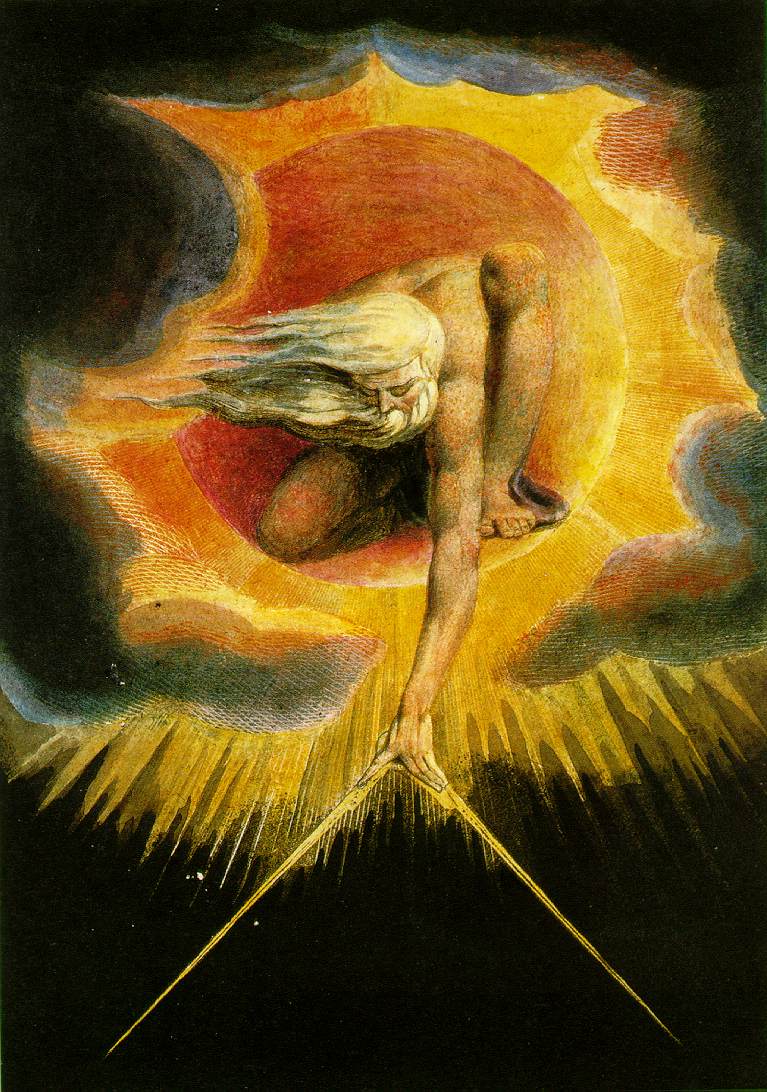
William Blake - Ancient of Days
One of the things about cancer is that there really are no (or at least very few) absolutes in treatment.  They have things that "usually" work or "often" help, but there's no real guarantee that it will work for me.

This is one of the hardest things for me to deal with.  I don't like to take chances and I'm very, very fond of sure things.

People who work with cancer do, of course, absolutely know what works a lot of the time.  They know if something has been proven to work better than other things, plus they understand the reasons certain things should be effective (for instance, my cancer, both in the original tumor and now in the bone, has been tested and found to have estrogen receptors, so depriving it of estrogen is considered a good approach because it both fits the science and has worked in controlled trials for others with similar cancer characteristics).

But, with cancer (like, unfortunately, with so many things) there is still a chance it won't work. Kind of like how I had the "most likely to cure this" treatments last time and yet....

Basically, there are still a lot of unknowns.

In the next week, I'll have been off the tamoxifen (no longer my best friend) long enough to "officially" have it out of my system and be ready to start the next treatment plan (the Xgeva I started a few weeks ago is intended to help prevent further bone damage from the cancer, but it's not supposed to kill the beast).  The plan is to move on to a different kind of anti-hormonal drug (probably an estrogen downregulator, possibly with or instead an aromatase inhibitor, both of which are different than an estrogen blocker like tamoxifen was, for those keeping track or playing cancer treatment bingo).  If that works, then great!  And hopefully it will work and work for a long time.  But, if not, I will probably be on to chemo fairly soon (then, hopefully that will work and work for a long time).

But, of course, we won't know what will happen to the cancer until it actually happens.

For now, with this next treatment plan, the question is which particular estrogen treatment (there are seveal out there for post-menopausal/post-chemopausal women to choose from) and what else goes with it.  And, for now, the non-answer answer is, "it depends."

As I mentioned in an earlier post, my oncologist is recommending a clinical trial for me.  I'm hoping it pans out.  There are a lot of pieces that have to fall into place for it.  Things that do look likely to fall into place, but it's not a sure thing.

The trial is just opening up--in a way that feels very cool because if I was diagnosed even a month before I was, I would have already been on an aromatase inhibitor or estrogen downregulator and not eligible for the trial, so that feels like a good sign--but, because it's just opening up, my hospital's institutional review board still needs to approve it for their patients.  They were meeting at the end of last week, so hopefully that's done with, but if they were to put off making a decision, we wouldn't put off treatment (because cancer) so that would mean I'm out of the trial.

If it is now approved by the IRB, there are still some tests I need to "pass" to meet the requirements.  I should pass them, no problem, but there's a chance that I won't.  Wouldn't be the worst thing ever, of course, because I'd still go on one of the standard treatments, but it would be disappointing.

And if it's approved and I'm approved, there's still a chance the institution coordinating the trial will have delays in opening it on their end.  Which would also mean I'd be out of it.

But, even if all of that works like a clockwork (and I hope it does), there's still the fact that it's a double-blind clinical trial.  This particular one is, I believe (and my oncologist believes), a pretty good bet for someone like me who's not in dire straights and who's not already run through multiple treatments: it's testing 3 different currently on the market drugs to see if they work better together, so it's not testing a new product yet to be used in the larger world and, therefore, not testing things without long track records.  Also, it's a phase III trial, which means it's passed tests for dosing and safety already.  And, most importantly, no matter which "arm" of the trial I end up in (between drug plus 2 placebos, 2 drugs plus placebo, or 3 real drugs), I'll still be receiving the drug that is an accepted standard of care for someone in my situation in any of the 3 arms.  So that part, of course, is not at risk.

But it's kind of a gamble, even if I'm in the trial, as to which arm I'm in and which arm I should want be in.

I'm relying on faith (ok, faith combined with the knowledge that I'll still be getting good treatment no matter what else goes with it) that whatever I'm on will be "right".  I'm hoping for the best, and hoping it brings me to NED (no evidence of disease) and keeps me there for a very long time.

I try to remember that God has a plan for me even when I don't know what it is.  But, unfortunately, God doesn't promise eternal life on earth and doesn't promise there will be no trials in this life, either (trial/trial? I guess it works either way, right?), so there is that.

In the end, this trial could be one of many things that I'm not doing in life, it could be just another treatment that does or doesn't work for me against my cancer.  Or, you never know, it could just be the thing that saves me.

Here's hoping for that last one.  Whichever meaning of "trial" and "save" you want to apply to that, let's just put our hope in that one.

Monday, March 17, 2014

Why I Have Breast Cancer on My Femur

Thomas Cole - The Course of Empire: Destruction
Common thing to wonder: Why do you have breast cancer on your femur?

Philosophical answer:  Beats the heck out of me.  One day I work up and there it was.

Explanatory answer:  A lot of people are wondering why cancer on my bones isn't called bone cancer.

I know it sounds a little weird to say I have breast cancer on my bones, but there's actually a good reason for it.  It goes like this this: cancer isn't an invader, at least not in the classical sense.  Cancer isn't something I "caught" from the outside the way you would a virus or germ.  My cancer is all me.  All natural.  Completely homegrown.

Cancer is my own cells, in this case cells from the milk ducts my (former) breast that went a little crazy.  One or two of my own cells changed a bit and overcame the things that would normally keep them in line and kept them growing in nice, tidy, duct-like ways.  Insteasd, they got out of control and kept growing willy-nilly, dividing and redividing and forming a couple of masses made up of cloned copies of their mutated selves.

The masses got big and broke through the ducts where they started, spilling into to the surrounding tissue.  They continued growing and even added access to my blood supply to continue feed the bulk of them as the mass grew larger and larger. At some point, some cells broke off and left the area in search of new places to colonize.  Some traveled through the lymphatic system, which is why I had cancer in and around the lymph nodes under my arm.  Some may have gone through the blood system, too, but there's no way to know for sure about that.

What we can tell is that in their quest for world domination, when these cells left the breast they formed new lesions on my bones, making a new home on particularly bones that have a rich blood supply and can feed them in a manner consistent with their needs.

Without intervention, they just keep growing and trying to spread out without realizing that in doing so they're jeopardising the very thing they need to survive.

Brief semi-religious deviation: I think of these cancerous cells like Adam and Eve in the garden.  They want to be like God but they only know the parts of God they themselves experience and have no idea of all the things outside of themselves that being God involves (of course, clearly, neither do I).  These cancerous cells seem hell bent on taking over, spreading out and pushing their way into the places of me that will best support their continued growth and quest for domination.  But  what they don't understand is, if they win, they really lose.  They can't be the God of me because taking over everything would kill me and without me there is no them.  Their view is limited to the inside of my body and they act like they think my body is all there is and could support them forever no matter what they do.

Stupid cancer.

Continued somewhat anthropomorphic but otherwise factual explanation: So now they've set up shop on a few of my bones.  But they aren't bone cells gone rogue (which would make them real bone cancer), they're still breast cells. Breast cells with mutations that have colonized on my bones, but breast cells nonetheless.

And the important thing is, they still act like mutated breast cells.  They have some characteristics that come from those ductal cell origins that, hopefully, can be be used against them to stop them or at least seriously slow them down.

But if we were to treat them like bone cells gone all crazy on me, that wouldn't work so well because bone cells don't act the same way as breast cells (which, actually, probably goes without saying) and bone cancer doesn't necessarily react to treatments the same way breast cancer does.  Even when the breast cancer is currently thriving in my bones.

And that's how I came to have breast cancer on my femur.

Saturday, March 15, 2014

Radiant (everything you ever wanted to know about me and radiation oncology)

Garth Williams - from Charlotte's Web
(one of Charlotte's words for Wilber is "Radiant")
The other day I went in to see my radiation oncologist.

For those of you not in cancer world, the oncologist breakdown is like this: solid tumor cancer treatment teams can involve both a medical oncologist and a radiation oncologist.  The medical oncologist is the one who takes care of the drug treatments and manages that care and all the follow-ups when care is done. The radiation oncologist plans and follows radiation therapy treatments.  But, not every cancer patient would benefit from radiation therapy, just like not every cancer patient needs chemo.

When I say "my oncologist" I'm generally talking about my medical oncologist, but, as I mentioned, I have a radiation oncologist, too.

My radiation oncologist is just the nicest woman. She's from Russia and starts conversations with phrases like, "well, my dear..." And, she clearly cares deeply about her patients.  If you've ever heard the phrase "salt of the earth," this is who that phrase was meant for.

And, she's not the only one in that office who's lovely.  The women at the front desk act like they've known you forever--and are happy about it.  My radiology oncologist's oncology nurse, who worked with me during my last radiation treatments to help keep tabs on my situation and give me solutions for my side effects (in 2012, mainly a nice red sunburn like skin reaction, which is common, but not, fortunately, the open wounds which sometimes follow), stopped by while I was waiting to go in this time to chat and see how I was doing.

And the radiation therapists (the professionals who run the machines to administer the radiation according to the radiation oncologist's treatment plan) treat me like a person (which, as you know, I am), with caring and respect and never any indication that I might really be just one more task on a long day's list of tasks (which, let's face it, I probably also am).

So, anyhow, the place is full of really nice people who seem to actually work in medicine because they want to help patients.  And a couple of days ago, all these really nice people agreed to shoot me full of radiation from multiple angles 5 days a week for 4 weeks.  And I agreed to let them.

Back in 2012, because I wasn't stage IV back then, the chemotherapy was intended to hunt down and kill any cancer that might have spread through my body and the radiation was in the areas where the known cancer had been (right upper chest and axial lymph nodes) to kill any cells that might have escaped the surgery and chemo.  The hope was that between them, the chemo and radiation therapy would cure me of cancer.

It was a good effort.

At this point, though, the horse is clearly out of the barn, so to speak, and the cancer has moved on to several unconnected spots on my bones, so radiation is no longer with "curative intent."  If they tried, they could probably get all the bone lesions they know about, but the assumption is that since my cancer has already shown that it's out of the breast and onto the bones, there are probably more cells lurking about that are too small to see but that would still grow into a problem (no worries, though, because medical oncology still has a plan to slow them down).  

But, even without radiation for a cure, they still do give radiation therapy to stage IV patients if the tumor is causing pain or other unpleasant symptoms and it's in a place that can safely be radiated. In those cases, they'll take care of it.

I have lesions on my pelvis, femur, rib, and a bone in my neck, but it's really only the ones in the pelvis/femur that are causing me any pain.  Those were the ones that lead us to investigate the pain and led to this diagnosis (the rib and cervical spine ones showed up on the PET-CT, but they weren't what we were in there to look at at them at the time, in fact, I wasn't even aware of them until I talked to my medical oncologist after the biopsy).

At first, I thought I wouldn't try to get the painful mets radiated.  I was doing ok with regular doses of simultaneous Tylenol and Advil and the occasional stronger drug in the evening and at night, at least as long as I rested it as much as possible and avoided shoes with heels, avoided moving it too far in any direction, avoided coming down hard on that leg for any reason, and walked carefully so as to gently roll through the limited range of motion each time I took a step, and only walk or otherwise put pressure on that leg when I really needed to.

I swear, that actually seemed like a pretty reasonable solution at the time.

But now I've decided to go on and let them help.

The hope is that, eventually, the hormone blockers would do enough to the cancer to let the bone heal and that should make the pain stop.  But, radiation therapy would also relieve the pain, and in a whole lot less time.

So, suddenly, after dealing with this hip pain getting more and more painful since Autumn, after taking pain killers for weeks, after being careful to move carefully or not move at all, getting this taken care of as soon as possible seemed like it was actually a very good idea. And, being able to take an actual walk outside when the weather turns spring-like and beautiful seems like a wonderful goal.

Before they give you the radiation they plan it carefully.  By the time I got there for this most recent appointment, my radiation oncologist had already studied my PET-CT images and knew the goal.  So I lay on a specialized CT table, my legs held by a customized form to keep me in the same position each time, and they took some more images, gave me 3 little tattoos to serve as guide marks (fun to think of myself as all tatted up, but in reality they're just three tiny black dots that look like freckles and match the other 3 tiny black dots from my first course of radiation), and sent me on my way with a check-in badge and a schedule of appointments.

Now they get to do the hard stuff, which is figuring how to angle the beams so they converge on the lesions and don't cross each other too much in other places (places like those pesky internal organs I like to keep in my lower torso).  Do you remember in "Ghostbusters" where Harold Ramis tells Bill Murray, "Don't cross the streams," and when Bill Murray's character asks why, the answer is, "It would be bad"?  Well, crossing too many radiation beams is kind of like that.

So, in about a week, they'll have things all mapped out and ready to go. I'll show up, lay on a table for about 20 minutes, keep doing that each weekday for 4 weeks, and the people in the know will slowly but surely force these lesions to leave me the heck alone.

Sounds like a plan to me.


*If you want more info on radiation therapy, I highly recommend the video at the bottom of the page here.  And, actually, the rest of the site, too.

*If you happen to have read Anne Tyler's Beginner's Goodbye, you may remember Dorothy was referred to as an "Oncology Radiologist." From the description of her job in the book, it's pretty clear she was actually a radiation oncologist.  A radiologist reads imaging studies (X-rays, CT scans, MRIs) and, although I couldn't rule it out entirely, I'm pretty sure "Oncology Radiologist" isn't really a job, at least not in the US.